
Month: August 2026

FX Report 2026 Week 35
Executive Summary
Actual currency performance this week was modest. The U.S. dollar strengthened slightly against all six major currencies tracked, ranging from essentially unchanged against the Australian dollar to a 0.89% advance against the Swiss franc, with the euro, British pound, Japanese yen, and Canadian dollar each softening by roughly 0.6%–0.75% against the dollar. That measured price action stood in contrast to a substantial rise in FX derivatives participation: CME FX futures notional volume rose approximately 74% over the week (from $53.9 billion to $93.6 billion), and FX options notional volume more than quadrupled ($2.25 billion to $9.83 billion), concentrated overwhelmingly in the euro.
Within FX options, the euro and Swiss franc — the week’s two weakest currencies in spot terms — also showed the clearest shift toward put-side (downside) positioning: EUR put share of options notional rose from 56% to 76%, and CHF options flipped from call-led to put-led. By contrast, the Australian dollar was essentially flat in spot terms despite persistently put-tilted options activity, and the yen softened only modestly even as its options activity remained call-tilted throughout — a reminder that this week’s options positioning did not move in lockstep with spot price for every currency.
In U.S. rates, SOFR futures and options volume both surged on Friday alongside a continued decline in SOFR settlement prices across the curve, consistent with a rise in near-term implied rates. Treasury activity told a more two-sided story: Treasury futures volume and open interest fell to their weekly lows by Friday, while Treasury options volume surged to a weekly high that same day and the put share of options activity — which had built for three straight sessions to a Thursday peak of nearly 59% — reversed to about 52% on Friday, most sharply in the 30-year sector.
The week’s macro backdrop centered on the three-day Jackson Hole Economic Symposium (August 27–29) and a Friday address from Fed Chairman Warsh, alongside a hotter-than-forecast Australian CPI print, a U.S. GDP Price Index reading above forecast, better-than-expected U.S. jobless claims, and a Canadian GDP beat paired with a much smaller downward U.S. payrolls revision than the prior period. For businesses with cross-border currency exposure or floating-rate financing, the combination of modest spot moves and sharply elevated derivatives participation argues for a hedge-coverage review — particularly for EUR and CHF exposures — rather than a reaction to outsized currency swings, which the data do not show.
1. Foreign Exchange & Options
Spot Performance
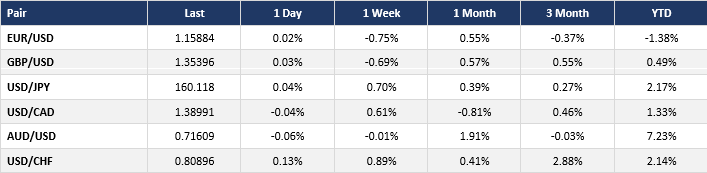
Spot price data (below) show broad but modest U.S. dollar strength this week. AUD/USD was essentially unchanged (-0.01%), the steadiest of the majors, while USD/CHF posted the week’s largest move (+0.89%, i.e. franc softening). EUR/USD, GBP/USD, and USD/CAD each moved 0.6%–0.75% against the dollar, and USD/JPY was little different, up 0.70%. None of these weekly moves were unusual relative to the pairs’ own 1-month and 3-month ranges, and technical readings across the majors were generally neutral to modestly favorable for the dollar side of each pair — including an elevated CCI reading on USD/JPY consistent with that pair’s well-established longer-term uptrend (USD/JPY is up 9.01% over the trailing year) — without signaling an extended or unusual move this week specifically.
Futures & Notional Activity
Beneath this comparatively modest price action, FX derivatives participation increased sharply. Aggregate CME FX futures notional volume rose from approximately $53.9 billion on Monday to $93.6 billion on Friday, with the euro accounting for 28%–43% of daily futures notional value and the yen a consistent second. The increase in participation, without a corresponding increase in spot-price movement, may reflect increased hedging, positioning, or event-related activity during a week that included the Jackson Hole Symposium and month-end positioning. The data do not establish a specific cause.
Options Positioning
FX options notional value rose from $2.25 billion on Monday to $9.83 billion on Friday, again led by the euro. EUR put notional value rose from roughly 56% of total EUR options notional on Monday to approximately 76% by Friday, increasingly concentrated in short-dated (within-one-week) expirations. CHF options flipped from call-led (57%) to put-led (58%) over the same period, alongside the week’s largest spot move. GBP put concentration, the most lopsided of the majors on Monday (85%), moderated to about 61% by Friday even as overall GBP options volume nearly tripled. AUD options remained consistently put-tilted (57%–58%) all week despite flat spot performance, and JPY options remained consistently call-tilted (52%–54%) despite the yen’s modest softening — in both cases, a divergence between options positioning and the week’s actual spot direction. As always, options activity of this kind can reflect hedging, speculation, or multi-leg strategies, and should not be read as a directional forecast.
2. Rates & Macro
SOFR futures volume held in a relatively narrow range from Monday through Thursday (3.15–3.60 million contracts) before jumping to 6.07 million on Friday, while SOFR options volume rose even more sharply, from 549,000 contracts on Monday to 2.30 million on Friday. SOFR settlement prices declined across nearly every point on the futures curve over the week, most pronounced in longer-dated contracts — consistent with a rise in the rate implied by the futures market. The SOFR options put/call balance shifted only modestly toward calls by Friday (56% versus 51% on Monday) even as volume on both sides rose several-fold, consistent with a broad-based increase in positioning activity rather than a one-sided shift.
Treasury futures volume and open interest both declined through the second half of the week, falling to their weekly lows on Friday (futures volume of 10.3 million contracts, down roughly 59% from Monday and 69% from Tuesday’s mid-week peak of 33.6 million). Treasury options activity moved differently: options volume surged to a weekly high of 1.83 million contracts on Friday, more than double Thursday’s level, even as options open interest eased from Thursday’s peak and the put share of options volume — which had risen for three straight sessions to 58.6% on Thursday — reversed to 52.1% on Friday, most sharply in the 30-year sector (43.5% to 28.8% put share). The pattern is more consistent with a burst of active repositioning coinciding with Friday’s scheduled Fed Chair remarks than with a sustained one-directional build in rate-market hedging.
The week’s economic calendar centered on the Jackson Hole Economic Symposium (August 27–29) and Fed Chairman Warsh’s Friday address, alongside a hotter-than-forecast Australian CPI print on Tuesday (headline CPI y/y of 3.5% versus 3.3% forecast), a U.S. GDP Price Index reading above forecast on Wednesday (6.4% versus 6.2%), better-than-expected U.S. jobless claims on Thursday (203,000 versus 208,000 forecast), and a Canadian GDP beat alongside a much smaller downward revision to prior U.S. payrolls figures on Friday. The source materials reviewed did not include the text of Treasury Secretary Bessent’s or Fed Chairman Warsh’s remarks, so this report does not characterize what was said in either appearance.
3. Cross-Market Observations
- The euro and Swiss franc were the only two majors where a weekly softening in spot price was accompanied by options activity that shifted toward, or remained concentrated in, puts by Friday — in the franc’s case, a shift from call-led to put-led positioning alongside the week’s largest currency move. This alignment is consistent with, though does not prove, hedging or positioning activity that anticipated or responded to the currency’s actual softening.
- By contrast, the Australian dollar was essentially flat for the week even though AUD options remained consistently put-tilted, and the yen softened modestly even though JPY options remained call-tilted throughout — two cases where options positioning did not track the direction of the week’s actual spot move, underscoring that options activity should not be read as a reliable predictor of near-term price direction.
- FX options activity reached its weekly high on Thursday and Friday, coinciding with the opening days of the Jackson Hole Symposium and Friday’s Fed Chairman Warsh remarks, even as the week’s actual currency moves remained modest — a pattern consistent with elevated hedging or positioning activity around a policy-communication event rather than an unusually volatile trading week.
- Treasury futures activity fell to its weekly lows by Friday while Treasury options volume surged and its put-share build partially reversed, whereas SOFR settlement prices continued their decline across the curve into Friday — suggesting the SOFR and Treasury markets may have processed Friday’s developments somewhat differently, a distinction worth continued monitoring.
4. WFG Market & Corporate Risk Monitor
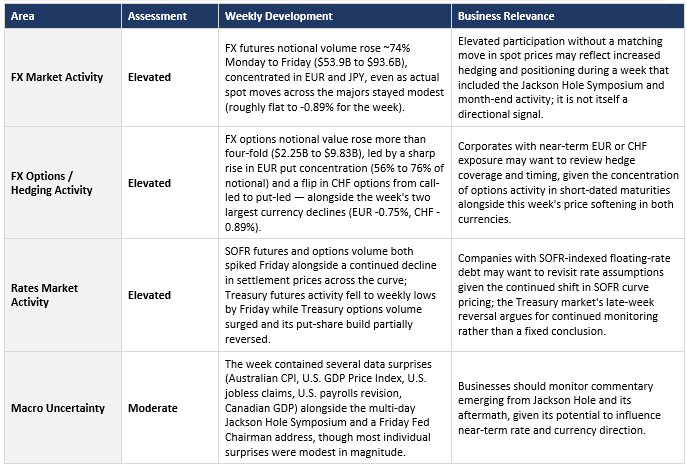
The assessments below reflect a qualitative reading of this week’s CME activity, spot-FX performance, and economic-calendar data; they are not derived from a quantitative risk-scoring methodology. Note that “Elevated” below describes market participation and hedging activity, not confirmed currency volatility — this week’s actual spot moves were modest, as detailed above.
5. What This Means for Businesses
This week’s actual currency moves were modest by historical standards — the dollar strengthened only slightly against most majors, led by a 0.89% advance against the Swiss franc and a 0.75% advance against the euro, while the Australian dollar was essentially unchanged. Beneath that modest price action, FX derivatives participation rose sharply, particularly in EUR and CHF options, where downside (put-side) activity became increasingly concentrated in short-dated expirations by week’s end. For companies with EUR or CHF payables, receivables, or budget exposure over the coming weeks, this combination — a real but modest currency move alongside a much larger increase in near-term hedging and positioning activity — may be a reasonable prompt to review existing hedge coverage and timing, without treating the week as evidence of a larger directional trend.
In the rates markets, SOFR pricing moved consistently through the week toward higher implied near-term rates, while Treasury market positioning was more unsettled, building through Thursday and partially reversing on Friday alongside a surge in trading volume coinciding with Fed Chairman Warsh’s scheduled remarks. Corporate treasurers with SOFR-indexed floating-rate debt or upcoming financing decisions may want to revisit rate assumptions in light of the SOFR curve’s move, while recognizing that Treasury-market positioning remains unsettled and may continue to evolve as Jackson Hole commentary is digested in the days ahead.