
Category: FX Weekly Report

FX Report 2026 Week 39
Executive Summary
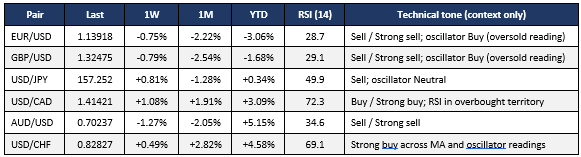
- Broad dollar strength, led by CAD and JPY. The U.S. dollar advanced against all six major pairs captured. USD/CAD posted the week’s largest move (+1.08%) and USD/JPY gained 0.81%, while EUR/USD (-0.75%) and GBP/USD (-0.79%) fell into oversold territory (RSI below 30). AUD/USD recorded the largest decline among the six (-1.27%) despite a strong domestic employment report.
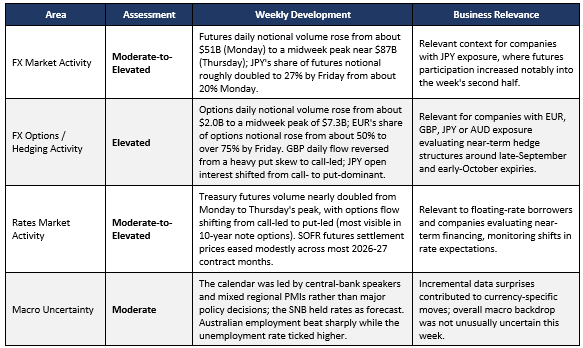
- FX derivatives activity built through the week and concentrated sharply in EUR options. Daily options notional volume rose from about $2.0 billion Monday to a midweek peak near $7.3 billion, and EUR’s share of that volume rose from roughly half to more than three-quarters by Friday. Futures notional volume followed a similar path, rising from about $51 billion to a Thursday peak of about $87 billion.
- Options positioning reversed in GBP and JPY during the week. GBP daily options flow flipped from a heavy put skew Monday to call-led by Friday even as GBP/USD ended the week lower — a divergence worth monitoring rather than a directional signal. JPY open interest shifted from call-dominant to put-dominant over the week, a change that ran in the same direction as the yen’s spot weakness.
- Rates-market activity picked up materially, especially around midweek. Treasury futures volume nearly doubled from Monday to Thursday’s peak, and options flow shifted from call-led early in the week to put-led by Thursday. SOFR futures settlement prices eased modestly across most 2026-27 contract months, consistent with a modest firming in near-term rate expectations. This activity coincided with the Swiss National Bank’s policy decision and the bulk of the week’s PMI and employment data, without the CME data establishing a specific cause.
- The week’s data catalyst was concentrated on Wednesday and Thursday. Flash PMIs for the eurozone and UK were mixed (services outperformed manufacturing in the eurozone; the reverse in the UK), Australian employment beat sharply, the SNB held its policy rate at 0.00% as forecast, and U.S. jobless claims came in below forecast.
1. Foreign Exchange & Options
Spot performance
The dollar’s advance was broad rather than concentrated in one pair. USD/CAD’s 1.08% gain was the largest weekly move, and USD/CHF extended a multi-horizon uptrend (positive across all measured horizons, with a Strong Buy technical reading). EUR/USD and GBP/USD declined in parallel and both carried RSI readings below 30, alongside Sell / Strong Sell trend readings; their positive oscillator readings point to possible short-term countertrend pressure rather than a confirmed reversal. AUD/USD was the weakest performer of the week even though Wednesday’s employment report beat forecasts by a wide margin, while USD/JPY’s gain came within a profile that remains negative over one and three months, reading more as a rebound within a broader trend than a confirmed reversal.
Futures and open interest
CME data show futures participation building steadily through the week. Daily futures notional volume rose from about $51.0 billion on Monday to a peak of about $87.1 billion on Thursday before easing to about $82.7 billion Friday, a roughly 62% increase from Monday’s low to the week’s peak. Futures open interest was comparatively stable, ending the week about 0.9% higher at roughly $270.0 billion. Euro FX led daily futures notional every session; the more notable shift was in the Japanese yen, whose share of futures notional rose from about 20% Monday to nearly 27% by Friday as its dollar-value notional roughly doubled.
Options activity moved in a similar but more pronounced pattern: options notional volume rose from about $2.0 billion Monday to a midweek peak of about $7.3 billion Wednesday, settling near $5.6 billion Friday — still close to three times Monday’s level. Options open interest rose about 6.5% over the week to roughly $97.7 billion. The clearest structural change was concentration: EUR’s share of daily options notional rose from about 50% Monday to over 76% by Friday, a materially higher concentration than the roughly proportional increase seen in futures.
Options composition
EUR: Put activity exceeded call activity in both daily flow (about 70% put Monday, about 66% put Friday) and open interest (roughly 60% put both days), a persistent skew concentrated in the October 9 and November 6 expiries. This is consistent with continued demand for EUR downside protection rather than a directional forecast, and it lines up with EUR/USD’s oversold spot reading.
GBP: Daily flow told a different story from open interest. Monday’s put share of daily notional was about 93% (concentrated in the October 9 and December 4 expiries); by Friday, call activity led (about 58% of the day’s notional), driven largely by the October 16 and October 12 expiries. Open interest moved the other way, with the put share rising from about 79% to about 86% over the week. The combination — a reversal in fresh daily flow alongside a deepening structural put skew — is a divergence worth monitoring rather than a clean signal in either direction.
AUD: Puts persistently exceeded calls in both daily flow (about 90% Monday, about 68% Friday) and open interest (roughly 71–73% both days), notwithstanding Wednesday’s employment beat. Sustained put demand alongside AUD/USD’s largest weekly decline among the six pairs is a case where options positioning and spot direction moved together.
JPY: Daily flow was modestly put-led Monday and modestly call-led by Friday, but the more notable change was in open interest, which flipped from call-dominant (about 68% call Monday) to put-dominant (about 68% put Friday). That shift in options positioning moved in the same direction as USD/JPY’s weekly gain (yen weakness).
CHF and CAD: CHF options remained call-led in daily flow for most of the week, even as USD/CHF extended its uptrend and carried the strongest technical readings of the six pairs; CHF call open interest also fell sharply, from about $188 million to about $29 million, indicating a substantial unwind of existing call positions rather than fresh accumulation. CAD options were close to balanced between puts and calls in both daily flow and open interest throughout the week.
2. Rates & Macro
Economic backdrop
The week’s calendar was led by central-bank speakers rather than scheduled policy decisions for most of the period: ECB President Lagarde spoke Monday and Tuesday, and BOE Governor Bailey spoke Friday, with no material scheduled euro-area or UK data releases alongside those remarks. Wednesday brought flash PMIs across the eurozone and UK. Eurozone manufacturing PMIs missed forecasts in both France (50.3 vs. 50.9) and Germany (53.8 vs. 54.1), while services PMIs beat in both (France 51.4 vs. 48.3; Germany 52.9 vs. 49.9) — a services-over-manufacturing pattern. The UK showed the reverse: manufacturing PMI beat (52.0 vs. 51.5) while services missed (51.7 vs. 52.0). Also on Wednesday, Australian employment change beat sharply (39.5K vs. 21.5K forecast), though the unemployment rate ticked up to 4.6% from a forecast and prior reading of 4.5%.
Thursday’s calendar included the Swiss National Bank’s Monetary Policy Assessment and press conference, with the policy rate held at 0.00% as forecast. Canadian retail sales missed on the core measure (-0.7% vs. -0.5% forecast) while the headline reading came in slightly better than forecast (-0.7% vs. -0.8%), both still negative month-over-month. U.S. initial jobless claims were lower than forecast (197K vs. 201K), a modestly favorable labor-market reading. No Federal Reserve policy decision or major U.S. data release fell within this reporting week.
SOFR and Treasury markets
SOFR futures volume began the week at a five-day low of about 2.8 million contracts Monday, then rose to a midweek peak of about 5.7 million Wednesday before easing to about 4.7 million by Friday; open interest was comparatively stable, edging about 1.4% higher over the week. SOFR options volume followed a similar arc, peaking at about 2.1 million contracts Wednesday versus 0.9 million Monday. Options put/call volume carried a modest put lean throughout the week (roughly 53–57% put), without a sharp directional swing.
Treasury futures activity showed the more pronounced change: daily volume rose from about 4.9 million contracts Monday to a peak of about 11.4 million Thursday — nearly double Monday’s level — before easing to about 9.0 million Friday. Open interest rose every session, ending the week about 2.5% higher. Treasury options volume shifted from call-led early in the week (about 55% call Monday) to put-led by Thursday (about 58% put, the week’s most put-heavy session), moderating slightly by Friday (about 52% put); the shift was most visible in 10-year note options, where the put share of volume rose from about 47% Monday to about 60% Friday. Settlement data show SOFR futures prices easing modestly across most 2026-11 through 2027-06 contract months over the week, consistent with a modest firming in near-term rate expectations; the CME reports provide no stated explanation for the shift, and this report draws no conclusion about Treasury yield direction from activity data alone.
3. Cross-Market Observations
- A mid-week cluster of activity across FX, SOFR and Treasury markets. FX options volume, Treasury futures volume, and SOFR futures and options volume all reached or approached their weekly peaks around Wednesday and Thursday, coinciding with the SNB decision, the eurozone and UK flash PMIs, the Australian employment report, and U.S. jobless claims. The data do not establish that any single release drove this activity; the coincidence in timing is nonetheless a useful marker for the week.
- EUR derivatives concentration rose well beyond EUR’s spot move. EUR/USD’s weekly decline (-0.75%) was comparatively modest next to AUD/USD’s or GBP/USD’s, yet EUR’s share of options notional rose from about half to more than three-quarters of daily volume. Elevated derivatives concentration without a matching spot move is itself a notable condition, not evidence of a larger EUR price move to come.
- Options positioning agreed with spot direction in some currencies and diverged in others. AUD’s persistent put skew and JPY’s shift toward put-dominant open interest both moved in the same direction as each currency’s spot performance. GBP’s late-week flip to call-led daily flow, and CHF’s call-led daily flow alongside a weakening spot franc, ran the other way — a reminder that options activity reflects hedging, speculation and structured trades and should not be read as a directional forecast.
4. WFG Market & Corporate Risk Monitor
The assessments below are qualitative observations based on this week’s available market data. They are not quantitative risk scores, trading signals, or hedge recommendations.
5. What This Means for Businesses
What changed: the dollar strengthened broadly, options and futures participation built through the week with a sharp increase in EUR concentration, positioning reversed in GBP and JPY, and rates-market activity picked up materially around midweek alongside a modest firming in near-term SOFR-implied rate expectations. The points below are prompts for review, not hedge-execution recommendations.
- Importers and exporters. The dollar’s gains against EUR, GBP and AUD lowered the USD cost of payables in those currencies and reduced the USD value of receivables and overseas revenue denominated in them, relative to a week earlier. The opposite held for CAD, JPY and CHF exposures, where the dollar’s continued gains extend a multi-week pattern. Companies with budget rates set at earlier levels may want to revisit budget-rate sensitivity and translation effects across their currency mix.
- Hedge programs. The sharp rise in EUR options concentration and the persistent EUR and AUD put skews support reviewing hedge coverage and horizons for material exposures in those currencies, particularly around the late-September and early-October expiries where activity concentrated. The GBP and JPY reversals support additional monitoring of those positions rather than an inference about direction.
- Floating-rate exposure. The pickup in Treasury and SOFR market activity, together with the modest easing in SOFR futures settlement prices across most 2026-27 contract months, may warrant reviewing interest-cost sensitivity and the timing of near-term financing or refinancing decisions.
- Conditions to monitor. Whether EUR options concentration persists or normalizes; whether the GBP options reversal and the JPY open-interest shift continue or revert; activity around the October 9 and October 16 expiries; and whether the modest rise in near-term SOFR-implied rates extends into the following week. These are items for monitoring, not predictions.
As always, hedge ratios, hedge horizons, and forward or options coverage should be reviewed in the context of each company’s specific currency and rate exposures, payment timing, and risk tolerance, in consultation with WFG or another qualified advisor.
FX Report 2026 Week 38
Executive Summary
- Broad dollar strength. The U.S. dollar gained against all six major pairs captured. USD/JPY rose 1.60%, USD/CAD 1.15% and USD/CHF 1.13%, while EUR/USD fell 1.08%, GBP/USD 0.86% and AUD/USD 0.52%. The yen moved from the prior week’s standout performer (USD/JPY −1.31% in Week 37) to the weakest of the six against the dollar.
- Policy outcomes matched forecasts; U.S. data beat them. The economic calendar showed the Federal Reserve, Bank of England and Bank of Japan outcomes in line with forecasts, while U.S. retail sales, the Philadelphia Fed index and jobless claims all beat. SOFR futures pricing moved toward higher implied rates (about 11 basis points in 2027 contracts), with the largest one-day move on Wednesday, the Fed decision day, when SOFR, Treasury and FX options activity all peaked.
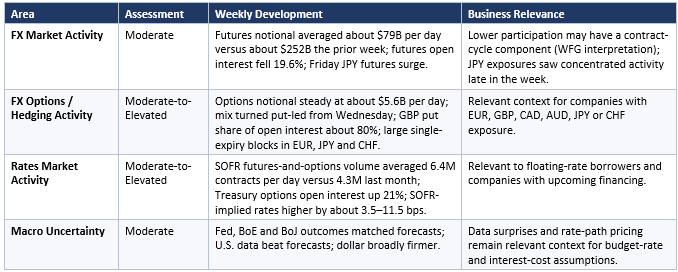
- Futures participation fell sharply while options activity held. FX futures notional averaged about $79 billion per day versus about $252 billion over the prior week’s four sessions, and futures open interest fell 19.6%; the CME reports do not state a cause. Options notional held near prior-week levels, with the mix shifting from call-led early in the week to put-led from Wednesday, mainly in euro options.
- A concentrated JPY burst on Friday. JPY futures notional reached about $38 billion (41% of the day’s total, roughly 2.9 times Thursday) and JPY options were call-weighted, in the first session after the BoJ decision. Call-side activity alongside a weaker spot yen is a divergence, not a directional signal.
1. Foreign Exchange & Options
Spot performance
The dollar advance was broad rather than concentrated. USD/JPY’s 1.60% gain was the largest move; EUR/USD and GBP/USD declined in parallel, and AUD/USD was the most resilient, remaining up 6.63% year-to-date. Positive values in USD-first pairs indicate a stronger dollar.
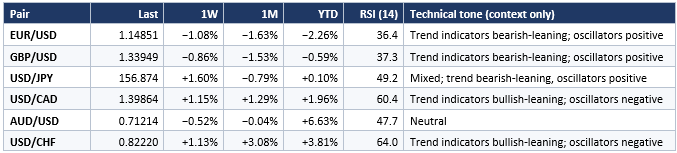
RSI sat in the mid-to-upper 30s for EUR/USD and GBP/USD and above 60 for USD/CAD and USD/CHF, below the conventional 70 overbought threshold. USD/JPY’s gain came within a negative one- and three-month profile (−0.79% and −2.78%), so the week reads as a rebound within a broader yen-strength trend rather than a confirmed reversal.
Futures and open interest
CME data show a sharp drop in futures participation from the prior week: notional traded averaged about $79 billion per day versus about $252 billion across the four sessions of September 8–11 (about 69% lower). Futures open interest fell from $333.7 billion on September 11 to $268.2 billion on September 18 (−19.6%), including a 19% drop on Wednesday. The CME reports do not state a cause; one possible contextual factor is the September quarterly contract cycle (WFG interpretation, not a documented cause). Euro FX led futures notional Monday through Thursday; the yen led on Friday ($38.0 billion versus $24.9 billion). Options behaved differently: notional averaged $5.6 billion per day, essentially unchanged from the prior four sessions (−0.6%), and open interest rose 6.8% to $91.6 billion. Euro options were 72% of the week’s options notional.
Options composition
Across all currencies, puts accounted for 52% of weekly options notional ($14.6 billion versus $13.4 billion for calls), but the balance changed during the week: calls led Monday (54%) and Tuesday (57%), while puts led Wednesday (56%), Thursday (60%) and Friday (52%). Put activity exceeding call activity is not, by itself, a bearish signal; it can reflect hedging, speculation or multi-leg structures.
- EUR: Calls and puts were nearly balanced for the week ($10.15 billion versus $10.11 billion), but single expiries drove the daily mix. Monday’s call lean was largely one June 2027 expiry ($1.63 billion of calls); Thursday’s put lean centered on the October 9 expiry ($1.49 billion of puts versus $0.29 billion of calls). Put-weighted open interest was stable at about 61–62%. Friday’s most active strike was 11.50 (which appears to correspond to 1.1500, near the 1.1485 spot close): 3,075 put lots versus 1,999 call lots for the September 25 expiry, consistent with near-the-money hedging or structured activity rather than a directional view.
- GBP, CAD, AUD: Puts were 63%, 65% and 59% of weekly options notional, respectively, alongside weaker spot for each against the dollar. GBP was the clearest case: put open interest rose from $184 million to $322 million while call open interest fell from $118 million to $81 million (put share about 61% to about 80%), consistent with increased demand for downside protection.
- CHF: The opposite pattern. Calls were 75% of weekly options notional, and $264 million of Friday’s $272 million was calls (September 25 and October 9 expiries), even as USD/CHF rose 1.13%.
- JPY: Friday stood apart: futures notional of about $38.0 billion (versus $13.0 billion Thursday) and options notional of $1.30 billion (versus $0.51 billion), with calls of $826 million against puts of $473 million, concentrated in October 9, September 25 and September 21 expiries. USD/JPY rose 0.58% that day. The mix cannot show whether participants were hedging, speculating or using multi-leg structures.
2. Rates & Macro
Economic backdrop
The week’s calendar centered on Wednesday’s Federal Reserve decision. The calendar listed the Federal Funds Rate at 4.00% (forecast 4.00%; previous 3.75%), so the outcome matched the forecast. The FOMC statement, projections and press conference were not among the materials reviewed, so this report does not characterize the decision or Fed communication. U.S. data beat expectations: retail sales rose 1.2% m/m (forecast 0.8%), core retail sales 1.4% (forecast 0.6%), the Philadelphia Fed manufacturing index was 37.8 (forecast 31.3, previous 47.4), and initial jobless claims were 196,000 (forecast 207,000).
Abroad, the Bank of England held at 3.75% as forecast, U.K. CPI was 3.1% y/y (in line; previous 2.9%) and U.K. retail sales rose 0.5% versus a forecast decline of 0.2%. The BoJ policy rate was listed as <1.25% (forecast <1.25%; previous <1.00%), matching the forecast. The calendar carried no scheduled euro-area data releases, only ECB President Lagarde speeches on Monday and Friday, so the euro’s decline occurred without a scheduled euro-area data catalyst.
SOFR and Treasury markets
SOFR futures-and-options volume peaked Wednesday at 9.8 million contracts, about 1.5 times the week’s five-day average (6.4 million) and about 2.3 times the prior month’s average (4.3 million); options volume that day (2.56 million) was roughly double Monday’s and Tuesday’s. All eight of Wednesday’s most active SR3 option strikes were puts, while Thursday’s mix rotated toward calls; the mix does not by itself establish a policy view. Futures open interest fell 7.9%, concentrated in the 2026-06 contract month (1.34 million contracts Monday, none by Friday), consistent with that contract rolling off; options open interest rose 7.3%.
Settlement prices provide the pricing evidence: SR3 futures fell across the curve, equivalent to implied rates rising about 3.5 basis points in the September 2026 contract and about 11–11.5 basis points in March, June and September 2027 contracts (WFG calculation from CME’s daily settlement changes). The largest daily move came Wednesday (about 9–10 basis points in March and June 2027), with a partial retracement in 2027 contracts Thursday and further declines Friday.
Treasury futures volume averaged 7.1 million contracts per day (8% below the prior four sessions) and peaked Wednesday at 8.7 million; futures open interest rose every session, ending 1.8% higher at 23.5 million. Treasury options open interest rose 21% to 8.6 million, concentrated in 10-year note options (October call open interest up 33% from Monday; November put open interest up 49%). Calls were 57% of weekly Treasury options volume versus about 46% in the prior four sessions. The Treasury reports measure participation rather than price, so WFG draws no conclusion on Treasury yield direction.
3. Cross-Market Observations
- Fed-day activity cluster. Wednesday saw the week’s peak in SOFR, Treasury and FX options activity, the largest daily SOFR repricing, and a higher put share in FX, SOFR and Treasury options versus Tuesday (the put lean persisted into Thursday only in FX options). This coincided with the Fed decision and strong U.S. retail sales; the data do not establish that either drove the activity or repricing.
- Large spot moves, subdued futures participation. Four pairs moved more than 1% while futures notional ran about two-thirds below the prior week’s pace, so the dollar’s advance was not accompanied by elevated futures volume (Friday’s JPY surge aside). The spot data cover weekly and Friday moves only, so daily timing cannot be established.
- Options mix and spot agreed in some currencies and diverged in others. Put-leaning options in GBP, CAD and AUD coincided with dollar strength against each, while call-side activity dominated in JPY and CHF even as both weakened. Options activity is not a forecast; the divergence shows that hedging and positioning demand did not uniformly follow spot direction.
4. WFG Market & Corporate Risk Monitor
The assessments below are qualitative observations based on this week’s available market data. They are not quantitative risk scores, trading signals, or hedge recommendations.
5. What This Means for Businesses
What changed: the dollar strengthened against every major pair captured, SOFR-implied rates moved higher, and options activity shifted toward puts in several currencies while diverging from spot in the yen and franc. The points below are prompts for review, not hedge-execution recommendations.
- Importers and exporters. The dollar’s gains lowered the USD cost of foreign-currency payables and the USD value of foreign-currency receivables and overseas revenue, relative to a week earlier. Companies with budget rates set at earlier levels, particularly in EUR (−2.26% YTD), JPY, CAD and CHF, may want to revisit budget-rate sensitivity and translation effects.
- Hedge programs. Put-leaning options activity in EUR (from midweek), GBP, CAD and AUD, with activity concentrated around late-September and early-October expirations, supports reviewing hedge coverage and horizons for material exposures in those currencies. The JPY and CHF divergence from spot supports monitoring rather than inference.
- Floating-rate exposure. With SOFR-implied rates higher across the curve and the calendar listing the Federal Funds Rate at 4.00%, companies with floating-rate debt or upcoming financing may want to reassess interest-cost sensitivity and refinancing timelines.
- Conditions to monitor. Whether USD/JPY momentum and JPY derivatives activity persist after the BoJ decision; activity around the September 25 and October 9 expiries; further movement in SOFR-implied rates; and whether the put-leaning mix in EUR and GBP options persists or reverts. These are items for monitoring, not predictions.
As always, hedge ratios, hedge horizons, and forward or options coverage should be reviewed in the context of each company’s specific currency and rate exposures, payment timing, and risk tolerance, in consultation with WFG or another qualified advisor.
FX Report 2026 Week 37
Executive Summary
U.S. dollar strength was broad-based against the major currencies this week, with one clear exception: the Japanese yen, which was the week’s standout performer as USD/JPY fell 1.31%. The euro, British pound, Australian dollar, Canadian dollar, and Swiss franc all softened against the dollar, led by a confirmed 0.42% decline in EUR/USD, which carried Sell-oriented technical readings across the board.
Beneath the spot move, CME derivatives activity told a more nuanced story. Futures notional trading fell by more than half between Wednesday and Friday, even as options notional activity continued to build — a pattern consistent with a shift toward optionality and hedging structures rather than outright futures positioning as the week closed. Euro options carried a persistent put lean for most of the week, Australian dollar options swung decisively toward downside puts by Thursday and Friday (coinciding with AUD/USD’s weekly decline), and British pound options carried a modest but consistent put tilt despite limited GBP spot movement and a stronger UK GDP release on Friday.
U.S. rates markets saw a marked pickup in activity during the back half of the week: SOFR and Treasury futures and options volumes roughly doubled from Tuesday-Wednesday levels to Thursday-Friday levels, and Treasury futures open interest built steadily each day. SOFR futures pricing also shifted progressively toward higher implied near-term rates over the week, with Friday recording the largest single-day move. This coincided with Thursday’s ECB rate decision and press conference and Friday’s stronger-than-expected U.S. Core CPI print, which provide relevant macro context without establishing direct causation.
1. Foreign Exchange & Options
Spot Performance
Spot price action for the week ending September 11 showed the U.S. dollar strengthening against every major currency captured except the Japanese yen. EUR/USD declined 0.42% for the week, closing at 1.15645, with Sell overall, Strong Sell moving-average, and Sell oscillator readings and a deeply negative CCI reading (-122.14) — a technically confirmed weekly decline. The move coincided with Thursday’s ECB decision to raise its Main Refinancing Rate 25 basis points to 2.65%, matching forecast; EUR/USD did not strengthen on the in-line outcome, consistent with the move having been largely anticipated. AUD/USD fell 0.65% for the week even as it remained up 7.07% year-to-date and 7.38% over one year, reflecting a near-term pullback within a longer-term uptrend. USD/CAD rose 0.28% (CAD softer) and USD/CHF rose 1.03% (CHF softer), the latter carrying Strong Buy overall and moving-average readings with RSI at 63.56 — firm but not overbought. GBP/USD was comparatively stable, down just 0.12% for the week with neutral overall, moving-average, and oscillator readings — a muted reaction even after Friday’s UK GDP m/m beat forecast (0.4% vs. 0.0%).
USD/JPY was the exception to the broad dollar-strength pattern, falling 1.31% for the week and standing out with Sell overall and Strong Sell moving-average technical readings — this week’s move extended a longer-term pattern of dollar weakness against the yen, with USD/JPY also down 3.44% over the past month and 3.94% over three months — consistent with sustained yen appreciation rather than yen weakness. RSI at 31.70 was near oversold territory on USD/JPY, while a modestly positive oscillator reading pointed to possible short-term stabilization within that broader downtrend for the pair.
Institutional Positioning: Futures & Notional Activity
CME FX futures notional trading activity built through midweek and then fell sharply into Friday: daily futures notional traded rose from roughly $291 billion on Tuesday to a weekly high of approximately $331 billion on Wednesday, before declining to $251 billion on Thursday and just $135 billion on Friday — less than half the midweek peak. The euro remained the dominant currency in futures notional throughout the week, ranging from 37.9% of daily futures notional on Friday to a peak of 50.8% on Wednesday; the Japanese yen was consistently the second-largest contributor, ranging between roughly 12.8% and 23.0% of daily futures notional.
Aggregate futures open interest, by contrast, stayed essentially stable across the week (approximately $332.7 billion on Tuesday to $333.7 billion on Friday, peaking near $337.8 billion on Wednesday), indicating that the swing in daily traded notional reflected changes in trading activity rather than a comparable swing in the underlying positioning base.
Options & Put/Call Positioning
FX options notional activity moved in the opposite direction of futures notional as the week progressed, rising from roughly $5.0 billion on Tuesday to approximately $6.2 billion by Friday — a steady build even as futures notional activity fell sharply over the same stretch. This divergence between declining futures participation and rising options participation into the week’s close is itself a notable development; it does not, on its own, indicate a directional view, but it is consistent with a shift toward options-based positioning or hedging structures rather than outright futures exposure.
Euro options carried a put-weighted skew across most of the week: put notional exceeded call notional by roughly 6.5 times on Tuesday and by nearly 3 times on Wednesday, before calls modestly outweighed puts on Thursday, then puts again outweighed calls by close to 1.7 times on Friday. Friday’s session also featured a clear expiration concentration: the single largest strike by both volume (5,968 lots) and open interest addition (6,248 lots) was a EUR put expiring the fourth week of September, positioned just above the prevailing spot level. This pattern is consistent with elevated demand for near-dated EUR downside protection rather than a directional forecast.
Australian dollar options showed a clear shift over the course of the week: call notional exceeded put notional on Tuesday and Wednesday, then reversed sharply, with put notional outweighing call notional by roughly 12 times on Thursday and by more than 2 times on Friday. This late-week tilt toward AUD downside puts coincided with AUD/USD’s 0.65% spot decline for the week, though the options data alone cannot establish that one caused the other.
British pound options carried a put-weighted skew in every session this week — a varying margin, generally more modest than the imbalances in EUR or AUD options — despite GBP/USD’s muted 0.12% weekly move and a stronger-than-expected UK GDP release on Friday (0.4% actual vs. 0.0% forecast). The lean persisting through a positive surprise reinforces that this is not a bearish signal on GBP; it is more consistent with steady, modest hedging decoupled from spot price action and headline data.
Japanese yen options were more evenly balanced across the week — alternating between modest call and modest put leans by session — despite the currency’s clear spot strength. The absence of a one-sided options skew alongside a clear directional spot move suggests two-way positioning around JPY strength rather than uniform directional conviction in the options market.
2. Rates & Macro
U.S. rates-market activity increased markedly during the second half of the reporting week. SOFR futures volume rose from roughly 3.1-3.2 million contracts on Tuesday and Wednesday to approximately 6.0 million on Thursday and 7.4 million on Friday, while SOFR options volume rose from roughly 1.1 million contracts midweek to 1.9 million on Thursday and 2.5 million on Friday. Combined SOFR futures-and-options open interest fell sharply on Friday, from roughly 56.0 million to 43.9 million contracts; this decline is attributable to the September 2026 SOFR options contract month, whose open interest dropped from approximately 12.8 million to just over 8,000 contracts between the two dates — consistent with routine expiration/settlement of that contract rather than a broad reduction in market positioning.
Treasury futures volume followed a similar late-week pattern, rising from roughly 6.2-6.3 million contracts on Tuesday and Wednesday to approximately 9.0-9.1 million on Thursday and Friday, while Treasury futures open interest built steadily and consistently each day, from about 22.74 million contracts on Tuesday to 23.09 million on Friday. Treasury options volume roughly doubled from about 1.05-1.10 million contracts midweek to approximately 2.24 million on both Thursday and Friday, with the put/call split remaining relatively balanced throughout (ranging from roughly 42% to 58% in either direction), indicating two-sided rather than one-sided participation across the Treasury options complex. On Friday specifically, 10-year Treasury note options carried the heaviest volume and open interest of any maturity, with October-expiry calls and puts both prominent among the most actively traded contracts.
On the pricing side, SOFR futures settlement levels moved progressively lower across the curve over the course of the week, which corresponds to the market pricing in modestly higher implied near-term interest rates than it had at the start of the week; the move accelerated on Friday, when several contract months recorded their largest single-day settlement change of the week. Thursday and Friday brought a cluster of high-impact releases relevant to this shift: the ECB raised its Main Refinancing Rate to 2.65% (in line with forecast, up from 2.40%) and held a press conference Thursday, U.S. Core PPI m/m came in below forecast (0.2% vs. 0.3%) the same day, and Friday brought an above-forecast U.S. Core CPI m/m (0.3% vs. 0.2%) alongside steady y/y CPI (3.4%). The timing coincides with the week’s rates-activity pickup and Friday’s repricing, though the data alone do not establish causation.
3. Cross-Market Observations
- Rates activity and dollar strength moved together. The broad-based dollar strength this week occurred alongside a sharp pickup in Treasury and SOFR trading activity, a progressive shift in SOFR futures pricing toward higher implied near-term rates, and a concentrated run of high-impact releases late in the week — Thursday’s ECB rate decision and Friday’s stronger U.S. Core CPI print. These developments are consistent with one another and occurred in the same window, though the data do not establish that any single release caused the broader moves.
- FX futures and options activity diverged into the week’s close. Futures notional trading fell by more than half between Wednesday and Friday, while options notional activity continued to build over the same period. This is a genuine divergence in market participation — not simply a lighter overall week — and is consistent with a shift toward options-based hedging or positioning as outright futures activity eased.
- AUD options positioning shifted alongside AUD spot weakness. AUD/USD’s 0.65% weekly decline coincided with a pronounced late-week shift in AUD options from a call lean (Tuesday-Wednesday) to a heavy put lean (Thursday-Friday). The timing is consistent with options activity tracking the spot move, though it cannot be established from the data that one caused the other.
- GBP options activity did not correspond to GBP spot movement. GBP/USD moved only 0.12% for the week — even after a stronger Friday GDP print — yet GBP options carried a modest but persistent put-weighted skew every session. The persistence of the options skew alongside limited spot movement illustrates a divergence between derivatives positioning and spot price action during the reporting period.
4. WFG Market & Corporate Risk Monitor
The assessments below are qualitative observations based on this week’s available market data. They are not quantitative risk scores, trading signals, or hedge recommendations.

5. What This Means for Businesses
This week’s broad-based dollar strength — against every major currency except the yen — is relevant to the USD cost of foreign-currency payables for U.S. importers, and to the USD value of foreign-currency receivables for U.S. exporters and multinational companies with EUR, GBP, AUD, CAD, or CHF revenue streams. Businesses budgeting around any of these currencies may want to revisit near-term budget-rate assumptions given the week’s move.
The divergence between falling FX futures activity and rising FX options activity, combined with the put-side skew observed in EUR, AUD, and GBP options this week, supports additional monitoring of hedge coverage for companies with material exposure to those currencies — particularly around near-dated expirations, where this week’s data showed the most concentrated activity. This observation is offered as a basis for review, not as a specific hedge-execution recommendation.
The pickup in Treasury and SOFR market activity, together with the modest upward shift in SOFR futures pricing, is most relevant to companies and corporate borrowers with floating-rate debt or upcoming financing needs tied to short-term U.S. rates. Given the timing of this activity alongside Thursday’s ECB rate decision and press conference and Friday’s stronger-than-expected U.S. Core CPI print, treasury teams may want to monitor upcoming U.S. data and Federal Reserve communications as this rate-pricing shift develops.
As always, hedge ratios, hedge horizons, and forward or options coverage should be reviewed in the context of each company’s specific currency and rate exposures, payment timing, and risk tolerance, in consultation with WFG or another qualified advisor.
FX Report 2026 Week 36
Executive Summary
Week 36 was shaped by a volatile U.S. labor-market data flow, the largest single-currency spot move of the week in the Japanese yen, and a rates market that visibly recalibrated around Friday’s employment report. Spot FX activity was concentrated at the extremes of the major-currency set: the yen posted the week’s strongest performance against the dollar while the Swiss franc was the softest. CME derivatives data showed FX futures and options participation building steadily through the week, with activity increasingly concentrated in EUR and JPY products. A soft ADP private-payrolls print mid-week gave way to a considerably stronger-than-expected nonfarm payrolls report on Friday, and CME Treasury options activity shifted from a put-dominant to a call-dominant composition over the same span. The Bank of Canada held its policy rate steady, even as Canada’s own Friday employment report disappointed sharply alongside a strong Ivey PMI reading. Treasury and short-term rate developments are discussed below primarily for their bearing on currency positioning, hedging conditions, and corporate financial risk.
1. Foreign Exchange & Options
Spot Performance and Relative Strength
Weekly spot performance was uneven across the major pairs. USD/JPY declined 1.99% for the week — the largest move among the six pairs tracked — placing the yen as the strongest major currency of the period; the pair also showed weak technical readings (a “sell” rating with an RSI near 33), consistent with sustained downward pressure through the week rather than a single-day event. At the other end, USD/CHF rose 0.69%, the strongest weekly gain in the set, making the franc the weakest major currency; technical readings for USD/CHF were firmly on the buy side. EUR/USD and GBP/USD each softened modestly (-0.33% and -0.50% respectively) but remain in positive territory over the trailing one- and three-month windows. USD/CAD was little changed (-0.13%), and AUD/USD posted a small weekly gain (+0.17%) that sits within a much stronger medium-term uptrend (+7.87% year-to-date).
Futures and Options Activity
CME FX futures activity built progressively over the week. Aggregate futures open interest rose each day, from roughly $292 billion on Monday to $319 billion by Friday — a gain of about 9%. Daily futures notional volume climbed from about $79 billion on Monday to a mid-week peak near $151 billion on Thursday before easing to $129 billion on Friday. Euro and yen futures remained the two largest products throughout the week by a wide margin, and both grew faster than the broader market: yen futures notional roughly doubled (from about $21 billion to $34 billion) and euro futures notional grew by a comparable proportion, concentrating an increasing share of total futures activity in the two currencies that also produced the week’s most notable spot moves.
Options activity told a related but distinct story. Total FX options notional volume rose from about $2.7 billion on Monday to $5.3 billion on Friday. Euro options remained the largest single component in dollar terms, but their share of total options notional fell from roughly 71% to 51% over the week as yen options notional grew nearly six-fold in relative share (from about 10% to 31% of the options total), concentrated heavily in short-dated (about one-week) expirations. Within euro options, put notional continued to exceed call notional across the week and became more concentrated at the October monthly expiration, where put notional grew from roughly $576 million to $806 million — consistent with increased demand for downside optionality in EUR at that later date rather than a directional call on the currency’s near-term path. This options activity should be read as a measure of hedging, speculative, and volatility-related participation; it is not, on its own, evidence of market expectations for currency direction.
2. Treasury and Rates
U.S. Treasury futures volume declined steadily through the week, from about 8.3 million contracts traded on Monday to 5.6 million on Friday — a decline of roughly a third — while open interest was essentially unchanged across the period (around 22.8 million contracts throughout). Treasury options activity moved in the opposite direction on the volume side, rising into the back half of the week, and its composition shifted meaningfully: on Monday, put volume represented about 59% of total Treasury options volume, but by Friday call volume represented about 54% of the total, with the shift occurring around midweek. The 10-year note remained the most actively traded options product across the week in both directions.
CME’s SOFR reports showed daily futures and options volumes and open interest holding within a fairly narrow range across the week, without a clear directional trend in participation. The more notable development appeared in the SOFR futures settlement strip: on Friday, settlement prices declined versus the prior session across essentially every listed contract month, with the decline more pronounced at longer-dated maturities (roughly 3-4.5 basis points at the back of the strip versus roughly 2-2.5 basis points at the front). A broad, longer-maturity-weighted move of that kind is consistent with a market digesting new information about the rate outlook, though the CME data alone does not establish what specifically drove it.
The week’s economic calendar supplied the likely macro backdrop for much of this rate-market activity. U.S. ADP private payrolls missed expectations badly on Wednesday (38,000 versus a 47,000 forecast, with the prior month revised down), while ISM Services PMI beat solidly on Thursday (55.4 versus 54.2 expected) even as ISM Manufacturing PMI missed on Tuesday (54.6 versus 55.2, still in expansion territory). Friday’s nonfarm payrolls report then came in well above expectations (162,000 versus a 55,000 forecast, with the prior month revised sharply higher to 21,000), while the unemployment rate held at 4.1%. In Canada, the Bank of Canada held its overnight rate at 2.25% as expected on Wednesday, but Friday’s employment report showed a sharp decline in Canadian jobs (-41,700 versus an expected gain of 15,100) alongside a strong Ivey PMI reading (64.3 versus 56.2 expected) — two releases pointing in different directions on the same day. Eurozone inflation data showed a similar internal tension: core CPI cooled slightly more than expected (2.4% y/y versus a 2.5% forecast) while headline flash CPI ticked up to 3.3% y/y from 2.9% previously. Swiss CPI surprised meaningfully to the upside (0.4% m/m versus a flat forecast), and Bank of England Governor Bailey delivered remarks on Friday for which no transcript was available in this week’s source materials.
3. Cross-Market Takeaways & WFG Perspective
- Yen strength was accompanied by a genuine build in yen-specific derivatives participation. USD/JPY’s outsized weekly decline coincided with the sharpest relative increase in both futures and options notional activity of any currency in the set — a case of derivatives participation confirming, rather than diverging from, the week’s clearest spot move.
- Euro spot was comparatively quiet even as euro options positioning shifted further toward downside protection at the October expiration. A modest weekly decline in EUR/USD occurred alongside growing put concentration further out on the calendar; the two developments are consistent with each other but the options data do not establish that the growth in downside hedging caused, or was caused by, the modest spot move.
- Rates-market positioning shifted over the same week that U.S. labor data sent conflicting signals. The move in CME Treasury options from put-dominant to call-dominant, and the broad, back-end-weighted decline in SOFR settlement prices on Friday, occurred alongside a soft ADP report followed by a strong payrolls beat — a sequence consistent with markets adjusting rate-market positioning as the data evolved, though CME’s activity data alone cannot confirm the specific driver.
- Canada’s Friday data presented a genuine divergence — a sizeable employment decline alongside a strong Ivey PMI — yet USD/CAD moved only modestly for the week. The muted spot reaction may reflect the offsetting nature of the two releases rather than a clear market verdict on either one.
- Treasury futures participation cooled through the week even as Treasury options volume and euro/yen FX notional activity built into Friday. The supplied data establish this divergence across products but do not indicate a specific cause; it is noted here as a pattern worth monitoring rather than an explained relationship.
4. What This Means for Businesses
Companies with material euro exposure — particularly those with payables or receivables settling around early-to-mid October — may want to review hedge coverage extending into that window, given the growing concentration of downside-protection activity at the October expiration alongside a comparatively quiet spot euro.
This was the most active week of the period for yen positioning, both in spot terms and across futures and options. Businesses with near-dated JPY commitments, or hedge programs sized around calmer historical conditions, may benefit from confirming that current hedge ratios and horizons remain appropriate.
The dollar’s strongest weekly gain among the majors was against the Swiss franc. This move may warrant reviewing CHF hedge coverage and upcoming payment exposures in light of the currency’s technical weakness over the week.
Canada’s split data picture — a sharp jobs decline alongside a strong business-activity reading — points to continued monitoring of incoming Canadian data before drawing conclusions about the near-term outlook for CAD-linked exposures.
The shift in Treasury options positioning and the broad, longer-maturity-weighted move in SOFR settlement pricing this week are modest developments individually, but together support a routine review of floating-rate exposure and related hedge documentation ahead of upcoming Federal Reserve-relevant data.
5. WFG Market & Corporate Risk Monitor
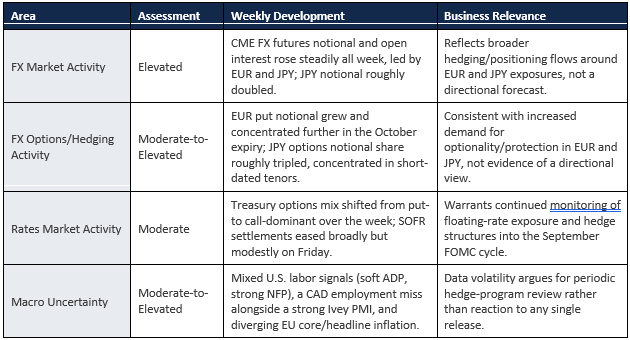
These are qualitative WFG assessments derived from the week’s available source materials, not quantitative risk scores or trading signals.
FX Report 2026 Week 35
Executive Summary
Actual currency performance this week was modest. The U.S. dollar strengthened slightly against all six major currencies tracked, ranging from essentially unchanged against the Australian dollar to a 0.89% advance against the Swiss franc, with the euro, British pound, Japanese yen, and Canadian dollar each softening by roughly 0.6%–0.75% against the dollar. That measured price action stood in contrast to a substantial rise in FX derivatives participation: CME FX futures notional volume rose approximately 74% over the week (from $53.9 billion to $93.6 billion), and FX options notional volume more than quadrupled ($2.25 billion to $9.83 billion), concentrated overwhelmingly in the euro.
Within FX options, the euro and Swiss franc — the week’s two weakest currencies in spot terms — also showed the clearest shift toward put-side (downside) positioning: EUR put share of options notional rose from 56% to 76%, and CHF options flipped from call-led to put-led. By contrast, the Australian dollar was essentially flat in spot terms despite persistently put-tilted options activity, and the yen softened only modestly even as its options activity remained call-tilted throughout — a reminder that this week’s options positioning did not move in lockstep with spot price for every currency.
In U.S. rates, SOFR futures and options volume both surged on Friday alongside a continued decline in SOFR settlement prices across the curve, consistent with a rise in near-term implied rates. Treasury activity told a more two-sided story: Treasury futures volume and open interest fell to their weekly lows by Friday, while Treasury options volume surged to a weekly high that same day and the put share of options activity — which had built for three straight sessions to a Thursday peak of nearly 59% — reversed to about 52% on Friday, most sharply in the 30-year sector.
The week’s macro backdrop centered on the three-day Jackson Hole Economic Symposium (August 27–29) and a Friday address from Fed Chairman Warsh, alongside a hotter-than-forecast Australian CPI print, a U.S. GDP Price Index reading above forecast, better-than-expected U.S. jobless claims, and a Canadian GDP beat paired with a much smaller downward U.S. payrolls revision than the prior period. For businesses with cross-border currency exposure or floating-rate financing, the combination of modest spot moves and sharply elevated derivatives participation argues for a hedge-coverage review — particularly for EUR and CHF exposures — rather than a reaction to outsized currency swings, which the data do not show.
1. Foreign Exchange & Options
Spot Performance
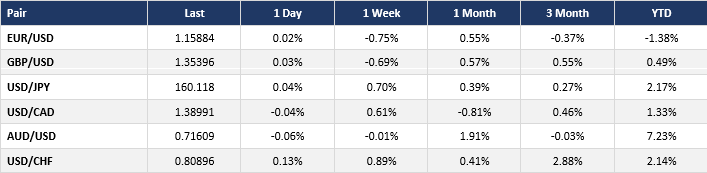
Spot price data (below) show broad but modest U.S. dollar strength this week. AUD/USD was essentially unchanged (-0.01%), the steadiest of the majors, while USD/CHF posted the week’s largest move (+0.89%, i.e. franc softening). EUR/USD, GBP/USD, and USD/CAD each moved 0.6%–0.75% against the dollar, and USD/JPY was little different, up 0.70%. None of these weekly moves were unusual relative to the pairs’ own 1-month and 3-month ranges, and technical readings across the majors were generally neutral to modestly favorable for the dollar side of each pair — including an elevated CCI reading on USD/JPY consistent with that pair’s well-established longer-term uptrend (USD/JPY is up 9.01% over the trailing year) — without signaling an extended or unusual move this week specifically.
Futures & Notional Activity
Beneath this comparatively modest price action, FX derivatives participation increased sharply. Aggregate CME FX futures notional volume rose from approximately $53.9 billion on Monday to $93.6 billion on Friday, with the euro accounting for 28%–43% of daily futures notional value and the yen a consistent second. The increase in participation, without a corresponding increase in spot-price movement, may reflect increased hedging, positioning, or event-related activity during a week that included the Jackson Hole Symposium and month-end positioning. The data do not establish a specific cause.
Options Positioning
FX options notional value rose from $2.25 billion on Monday to $9.83 billion on Friday, again led by the euro. EUR put notional value rose from roughly 56% of total EUR options notional on Monday to approximately 76% by Friday, increasingly concentrated in short-dated (within-one-week) expirations. CHF options flipped from call-led (57%) to put-led (58%) over the same period, alongside the week’s largest spot move. GBP put concentration, the most lopsided of the majors on Monday (85%), moderated to about 61% by Friday even as overall GBP options volume nearly tripled. AUD options remained consistently put-tilted (57%–58%) all week despite flat spot performance, and JPY options remained consistently call-tilted (52%–54%) despite the yen’s modest softening — in both cases, a divergence between options positioning and the week’s actual spot direction. As always, options activity of this kind can reflect hedging, speculation, or multi-leg strategies, and should not be read as a directional forecast.
2. Rates & Macro
SOFR futures volume held in a relatively narrow range from Monday through Thursday (3.15–3.60 million contracts) before jumping to 6.07 million on Friday, while SOFR options volume rose even more sharply, from 549,000 contracts on Monday to 2.30 million on Friday. SOFR settlement prices declined across nearly every point on the futures curve over the week, most pronounced in longer-dated contracts — consistent with a rise in the rate implied by the futures market. The SOFR options put/call balance shifted only modestly toward calls by Friday (56% versus 51% on Monday) even as volume on both sides rose several-fold, consistent with a broad-based increase in positioning activity rather than a one-sided shift.
Treasury futures volume and open interest both declined through the second half of the week, falling to their weekly lows on Friday (futures volume of 10.3 million contracts, down roughly 59% from Monday and 69% from Tuesday’s mid-week peak of 33.6 million). Treasury options activity moved differently: options volume surged to a weekly high of 1.83 million contracts on Friday, more than double Thursday’s level, even as options open interest eased from Thursday’s peak and the put share of options volume — which had risen for three straight sessions to 58.6% on Thursday — reversed to 52.1% on Friday, most sharply in the 30-year sector (43.5% to 28.8% put share). The pattern is more consistent with a burst of active repositioning coinciding with Friday’s scheduled Fed Chair remarks than with a sustained one-directional build in rate-market hedging.
The week’s economic calendar centered on the Jackson Hole Economic Symposium (August 27–29) and Fed Chairman Warsh’s Friday address, alongside a hotter-than-forecast Australian CPI print on Tuesday (headline CPI y/y of 3.5% versus 3.3% forecast), a U.S. GDP Price Index reading above forecast on Wednesday (6.4% versus 6.2%), better-than-expected U.S. jobless claims on Thursday (203,000 versus 208,000 forecast), and a Canadian GDP beat alongside a much smaller downward revision to prior U.S. payrolls figures on Friday. The source materials reviewed did not include the text of Treasury Secretary Bessent’s or Fed Chairman Warsh’s remarks, so this report does not characterize what was said in either appearance.
3. Cross-Market Observations
- The euro and Swiss franc were the only two majors where a weekly softening in spot price was accompanied by options activity that shifted toward, or remained concentrated in, puts by Friday — in the franc’s case, a shift from call-led to put-led positioning alongside the week’s largest currency move. This alignment is consistent with, though does not prove, hedging or positioning activity that anticipated or responded to the currency’s actual softening.
- By contrast, the Australian dollar was essentially flat for the week even though AUD options remained consistently put-tilted, and the yen softened modestly even though JPY options remained call-tilted throughout — two cases where options positioning did not track the direction of the week’s actual spot move, underscoring that options activity should not be read as a reliable predictor of near-term price direction.
- FX options activity reached its weekly high on Thursday and Friday, coinciding with the opening days of the Jackson Hole Symposium and Friday’s Fed Chairman Warsh remarks, even as the week’s actual currency moves remained modest — a pattern consistent with elevated hedging or positioning activity around a policy-communication event rather than an unusually volatile trading week.
- Treasury futures activity fell to its weekly lows by Friday while Treasury options volume surged and its put-share build partially reversed, whereas SOFR settlement prices continued their decline across the curve into Friday — suggesting the SOFR and Treasury markets may have processed Friday’s developments somewhat differently, a distinction worth continued monitoring.
4. WFG Market & Corporate Risk Monitor
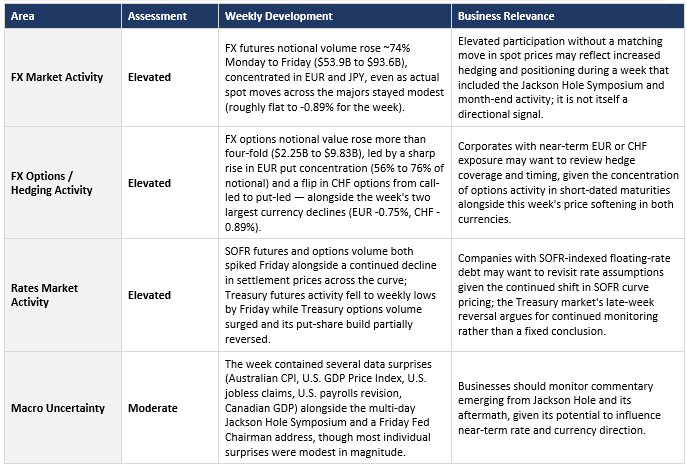
The assessments below reflect a qualitative reading of this week’s CME activity, spot-FX performance, and economic-calendar data; they are not derived from a quantitative risk-scoring methodology. Note that “Elevated” below describes market participation and hedging activity, not confirmed currency volatility — this week’s actual spot moves were modest, as detailed above.
5. What This Means for Businesses
This week’s actual currency moves were modest by historical standards — the dollar strengthened only slightly against most majors, led by a 0.89% advance against the Swiss franc and a 0.75% advance against the euro, while the Australian dollar was essentially unchanged. Beneath that modest price action, FX derivatives participation rose sharply, particularly in EUR and CHF options, where downside (put-side) activity became increasingly concentrated in short-dated expirations by week’s end. For companies with EUR or CHF payables, receivables, or budget exposure over the coming weeks, this combination — a real but modest currency move alongside a much larger increase in near-term hedging and positioning activity — may be a reasonable prompt to review existing hedge coverage and timing, without treating the week as evidence of a larger directional trend.
In the rates markets, SOFR pricing moved consistently through the week toward higher implied near-term rates, while Treasury market positioning was more unsettled, building through Thursday and partially reversing on Friday alongside a surge in trading volume coinciding with Fed Chairman Warsh’s scheduled remarks. Corporate treasurers with SOFR-indexed floating-rate debt or upcoming financing decisions may want to revisit rate assumptions in light of the SOFR curve’s move, while recognizing that Treasury-market positioning remains unsettled and may continue to evolve as Jackson Hole commentary is digested in the days ahead.