
FX Report 2026 Week 39


Executive Summary
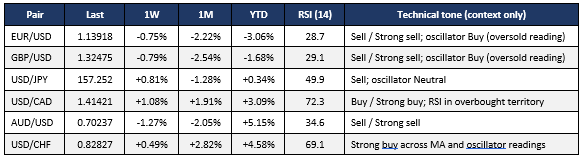
- Broad dollar strength, led by CAD and JPY. The U.S. dollar advanced against all six major pairs captured. USD/CAD posted the week’s largest move (+1.08%) and USD/JPY gained 0.81%, while EUR/USD (-0.75%) and GBP/USD (-0.79%) fell into oversold territory (RSI below 30). AUD/USD recorded the largest decline among the six (-1.27%) despite a strong domestic employment report.
- FX derivatives activity built through the week and concentrated sharply in EUR options. Daily options notional volume rose from about $2.0 billion Monday to a midweek peak near $7.3 billion, and EUR’s share of that volume rose from roughly half to more than three-quarters by Friday. Futures notional volume followed a similar path, rising from about $51 billion to a Thursday peak of about $87 billion.
- Options positioning reversed in GBP and JPY during the week. GBP daily options flow flipped from a heavy put skew Monday to call-led by Friday even as GBP/USD ended the week lower — a divergence worth monitoring rather than a directional signal. JPY open interest shifted from call-dominant to put-dominant over the week, a change that ran in the same direction as the yen’s spot weakness.
- Rates-market activity picked up materially, especially around midweek. Treasury futures volume nearly doubled from Monday to Thursday’s peak, and options flow shifted from call-led early in the week to put-led by Thursday. SOFR futures settlement prices eased modestly across most 2026-27 contract months, consistent with a modest firming in near-term rate expectations. This activity coincided with the Swiss National Bank’s policy decision and the bulk of the week’s PMI and employment data, without the CME data establishing a specific cause.
- The week’s data catalyst was concentrated on Wednesday and Thursday. Flash PMIs for the eurozone and UK were mixed (services outperformed manufacturing in the eurozone; the reverse in the UK), Australian employment beat sharply, the SNB held its policy rate at 0.00% as forecast, and U.S. jobless claims came in below forecast.
1. Foreign Exchange & Options
Spot performance
The dollar’s advance was broad rather than concentrated in one pair. USD/CAD’s 1.08% gain was the largest weekly move, and USD/CHF extended a multi-horizon uptrend (positive across all measured horizons, with a Strong Buy technical reading). EUR/USD and GBP/USD declined in parallel and both carried RSI readings below 30, alongside Sell / Strong Sell trend readings; their positive oscillator readings point to possible short-term countertrend pressure rather than a confirmed reversal. AUD/USD was the weakest performer of the week even though Wednesday’s employment report beat forecasts by a wide margin, while USD/JPY’s gain came within a profile that remains negative over one and three months, reading more as a rebound within a broader trend than a confirmed reversal.
Futures and open interest
CME data show futures participation building steadily through the week. Daily futures notional volume rose from about $51.0 billion on Monday to a peak of about $87.1 billion on Thursday before easing to about $82.7 billion Friday, a roughly 62% increase from Monday’s low to the week’s peak. Futures open interest was comparatively stable, ending the week about 0.9% higher at roughly $270.0 billion. Euro FX led daily futures notional every session; the more notable shift was in the Japanese yen, whose share of futures notional rose from about 20% Monday to nearly 27% by Friday as its dollar-value notional roughly doubled.
Options activity moved in a similar but more pronounced pattern: options notional volume rose from about $2.0 billion Monday to a midweek peak of about $7.3 billion Wednesday, settling near $5.6 billion Friday — still close to three times Monday’s level. Options open interest rose about 6.5% over the week to roughly $97.7 billion. The clearest structural change was concentration: EUR’s share of daily options notional rose from about 50% Monday to over 76% by Friday, a materially higher concentration than the roughly proportional increase seen in futures.
Options composition
EUR: Put activity exceeded call activity in both daily flow (about 70% put Monday, about 66% put Friday) and open interest (roughly 60% put both days), a persistent skew concentrated in the October 9 and November 6 expiries. This is consistent with continued demand for EUR downside protection rather than a directional forecast, and it lines up with EUR/USD’s oversold spot reading.
GBP: Daily flow told a different story from open interest. Monday’s put share of daily notional was about 93% (concentrated in the October 9 and December 4 expiries); by Friday, call activity led (about 58% of the day’s notional), driven largely by the October 16 and October 12 expiries. Open interest moved the other way, with the put share rising from about 79% to about 86% over the week. The combination — a reversal in fresh daily flow alongside a deepening structural put skew — is a divergence worth monitoring rather than a clean signal in either direction.
AUD: Puts persistently exceeded calls in both daily flow (about 90% Monday, about 68% Friday) and open interest (roughly 71–73% both days), notwithstanding Wednesday’s employment beat. Sustained put demand alongside AUD/USD’s largest weekly decline among the six pairs is a case where options positioning and spot direction moved together.
JPY: Daily flow was modestly put-led Monday and modestly call-led by Friday, but the more notable change was in open interest, which flipped from call-dominant (about 68% call Monday) to put-dominant (about 68% put Friday). That shift in options positioning moved in the same direction as USD/JPY’s weekly gain (yen weakness).
CHF and CAD: CHF options remained call-led in daily flow for most of the week, even as USD/CHF extended its uptrend and carried the strongest technical readings of the six pairs; CHF call open interest also fell sharply, from about $188 million to about $29 million, indicating a substantial unwind of existing call positions rather than fresh accumulation. CAD options were close to balanced between puts and calls in both daily flow and open interest throughout the week.
2. Rates & Macro
Economic backdrop
The week’s calendar was led by central-bank speakers rather than scheduled policy decisions for most of the period: ECB President Lagarde spoke Monday and Tuesday, and BOE Governor Bailey spoke Friday, with no material scheduled euro-area or UK data releases alongside those remarks. Wednesday brought flash PMIs across the eurozone and UK. Eurozone manufacturing PMIs missed forecasts in both France (50.3 vs. 50.9) and Germany (53.8 vs. 54.1), while services PMIs beat in both (France 51.4 vs. 48.3; Germany 52.9 vs. 49.9) — a services-over-manufacturing pattern. The UK showed the reverse: manufacturing PMI beat (52.0 vs. 51.5) while services missed (51.7 vs. 52.0). Also on Wednesday, Australian employment change beat sharply (39.5K vs. 21.5K forecast), though the unemployment rate ticked up to 4.6% from a forecast and prior reading of 4.5%.
Thursday’s calendar included the Swiss National Bank’s Monetary Policy Assessment and press conference, with the policy rate held at 0.00% as forecast. Canadian retail sales missed on the core measure (-0.7% vs. -0.5% forecast) while the headline reading came in slightly better than forecast (-0.7% vs. -0.8%), both still negative month-over-month. U.S. initial jobless claims were lower than forecast (197K vs. 201K), a modestly favorable labor-market reading. No Federal Reserve policy decision or major U.S. data release fell within this reporting week.
SOFR and Treasury markets
SOFR futures volume began the week at a five-day low of about 2.8 million contracts Monday, then rose to a midweek peak of about 5.7 million Wednesday before easing to about 4.7 million by Friday; open interest was comparatively stable, edging about 1.4% higher over the week. SOFR options volume followed a similar arc, peaking at about 2.1 million contracts Wednesday versus 0.9 million Monday. Options put/call volume carried a modest put lean throughout the week (roughly 53–57% put), without a sharp directional swing.
Treasury futures activity showed the more pronounced change: daily volume rose from about 4.9 million contracts Monday to a peak of about 11.4 million Thursday — nearly double Monday’s level — before easing to about 9.0 million Friday. Open interest rose every session, ending the week about 2.5% higher. Treasury options volume shifted from call-led early in the week (about 55% call Monday) to put-led by Thursday (about 58% put, the week’s most put-heavy session), moderating slightly by Friday (about 52% put); the shift was most visible in 10-year note options, where the put share of volume rose from about 47% Monday to about 60% Friday. Settlement data show SOFR futures prices easing modestly across most 2026-11 through 2027-06 contract months over the week, consistent with a modest firming in near-term rate expectations; the CME reports provide no stated explanation for the shift, and this report draws no conclusion about Treasury yield direction from activity data alone.
3. Cross-Market Observations
- A mid-week cluster of activity across FX, SOFR and Treasury markets. FX options volume, Treasury futures volume, and SOFR futures and options volume all reached or approached their weekly peaks around Wednesday and Thursday, coinciding with the SNB decision, the eurozone and UK flash PMIs, the Australian employment report, and U.S. jobless claims. The data do not establish that any single release drove this activity; the coincidence in timing is nonetheless a useful marker for the week.
- EUR derivatives concentration rose well beyond EUR’s spot move. EUR/USD’s weekly decline (-0.75%) was comparatively modest next to AUD/USD’s or GBP/USD’s, yet EUR’s share of options notional rose from about half to more than three-quarters of daily volume. Elevated derivatives concentration without a matching spot move is itself a notable condition, not evidence of a larger EUR price move to come.
- Options positioning agreed with spot direction in some currencies and diverged in others. AUD’s persistent put skew and JPY’s shift toward put-dominant open interest both moved in the same direction as each currency’s spot performance. GBP’s late-week flip to call-led daily flow, and CHF’s call-led daily flow alongside a weakening spot franc, ran the other way — a reminder that options activity reflects hedging, speculation and structured trades and should not be read as a directional forecast.
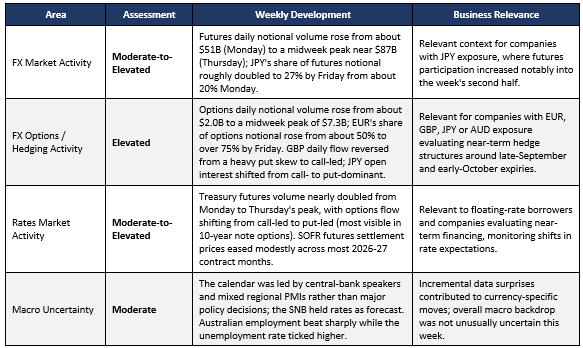
4. WFG Market & Corporate Risk Monitor
The assessments below are qualitative observations based on this week’s available market data. They are not quantitative risk scores, trading signals, or hedge recommendations.
5. What This Means for Businesses
What changed: the dollar strengthened broadly, options and futures participation built through the week with a sharp increase in EUR concentration, positioning reversed in GBP and JPY, and rates-market activity picked up materially around midweek alongside a modest firming in near-term SOFR-implied rate expectations. The points below are prompts for review, not hedge-execution recommendations.
- Importers and exporters. The dollar’s gains against EUR, GBP and AUD lowered the USD cost of payables in those currencies and reduced the USD value of receivables and overseas revenue denominated in them, relative to a week earlier. The opposite held for CAD, JPY and CHF exposures, where the dollar’s continued gains extend a multi-week pattern. Companies with budget rates set at earlier levels may want to revisit budget-rate sensitivity and translation effects across their currency mix.
- Hedge programs. The sharp rise in EUR options concentration and the persistent EUR and AUD put skews support reviewing hedge coverage and horizons for material exposures in those currencies, particularly around the late-September and early-October expiries where activity concentrated. The GBP and JPY reversals support additional monitoring of those positions rather than an inference about direction.
- Floating-rate exposure. The pickup in Treasury and SOFR market activity, together with the modest easing in SOFR futures settlement prices across most 2026-27 contract months, may warrant reviewing interest-cost sensitivity and the timing of near-term financing or refinancing decisions.
- Conditions to monitor. Whether EUR options concentration persists or normalizes; whether the GBP options reversal and the JPY open-interest shift continue or revert; activity around the October 9 and October 16 expiries; and whether the modest rise in near-term SOFR-implied rates extends into the following week. These are items for monitoring, not predictions.
As always, hedge ratios, hedge horizons, and forward or options coverage should be reviewed in the context of each company’s specific currency and rate exposures, payment timing, and risk tolerance, in consultation with WFG or another qualified advisor.