
FX Report 2026 Week 36

Executive Summary
Week 36 was shaped by a volatile U.S. labor-market data flow, the largest single-currency spot move of the week in the Japanese yen, and a rates market that visibly recalibrated around Friday’s employment report. Spot FX activity was concentrated at the extremes of the major-currency set: the yen posted the week’s strongest performance against the dollar while the Swiss franc was the softest. CME derivatives data showed FX futures and options participation building steadily through the week, with activity increasingly concentrated in EUR and JPY products. A soft ADP private-payrolls print mid-week gave way to a considerably stronger-than-expected nonfarm payrolls report on Friday, and CME Treasury options activity shifted from a put-dominant to a call-dominant composition over the same span. The Bank of Canada held its policy rate steady, even as Canada’s own Friday employment report disappointed sharply alongside a strong Ivey PMI reading. Treasury and short-term rate developments are discussed below primarily for their bearing on currency positioning, hedging conditions, and corporate financial risk.
1. Foreign Exchange & Options
Spot Performance and Relative Strength
Weekly spot performance was uneven across the major pairs. USD/JPY declined 1.99% for the week — the largest move among the six pairs tracked — placing the yen as the strongest major currency of the period; the pair also showed weak technical readings (a “sell” rating with an RSI near 33), consistent with sustained downward pressure through the week rather than a single-day event. At the other end, USD/CHF rose 0.69%, the strongest weekly gain in the set, making the franc the weakest major currency; technical readings for USD/CHF were firmly on the buy side. EUR/USD and GBP/USD each softened modestly (-0.33% and -0.50% respectively) but remain in positive territory over the trailing one- and three-month windows. USD/CAD was little changed (-0.13%), and AUD/USD posted a small weekly gain (+0.17%) that sits within a much stronger medium-term uptrend (+7.87% year-to-date).
Futures and Options Activity
CME FX futures activity built progressively over the week. Aggregate futures open interest rose each day, from roughly $292 billion on Monday to $319 billion by Friday — a gain of about 9%. Daily futures notional volume climbed from about $79 billion on Monday to a mid-week peak near $151 billion on Thursday before easing to $129 billion on Friday. Euro and yen futures remained the two largest products throughout the week by a wide margin, and both grew faster than the broader market: yen futures notional roughly doubled (from about $21 billion to $34 billion) and euro futures notional grew by a comparable proportion, concentrating an increasing share of total futures activity in the two currencies that also produced the week’s most notable spot moves.
Options activity told a related but distinct story. Total FX options notional volume rose from about $2.7 billion on Monday to $5.3 billion on Friday. Euro options remained the largest single component in dollar terms, but their share of total options notional fell from roughly 71% to 51% over the week as yen options notional grew nearly six-fold in relative share (from about 10% to 31% of the options total), concentrated heavily in short-dated (about one-week) expirations. Within euro options, put notional continued to exceed call notional across the week and became more concentrated at the October monthly expiration, where put notional grew from roughly $576 million to $806 million — consistent with increased demand for downside optionality in EUR at that later date rather than a directional call on the currency’s near-term path. This options activity should be read as a measure of hedging, speculative, and volatility-related participation; it is not, on its own, evidence of market expectations for currency direction.
2. Treasury and Rates
U.S. Treasury futures volume declined steadily through the week, from about 8.3 million contracts traded on Monday to 5.6 million on Friday — a decline of roughly a third — while open interest was essentially unchanged across the period (around 22.8 million contracts throughout). Treasury options activity moved in the opposite direction on the volume side, rising into the back half of the week, and its composition shifted meaningfully: on Monday, put volume represented about 59% of total Treasury options volume, but by Friday call volume represented about 54% of the total, with the shift occurring around midweek. The 10-year note remained the most actively traded options product across the week in both directions.
CME’s SOFR reports showed daily futures and options volumes and open interest holding within a fairly narrow range across the week, without a clear directional trend in participation. The more notable development appeared in the SOFR futures settlement strip: on Friday, settlement prices declined versus the prior session across essentially every listed contract month, with the decline more pronounced at longer-dated maturities (roughly 3-4.5 basis points at the back of the strip versus roughly 2-2.5 basis points at the front). A broad, longer-maturity-weighted move of that kind is consistent with a market digesting new information about the rate outlook, though the CME data alone does not establish what specifically drove it.
The week’s economic calendar supplied the likely macro backdrop for much of this rate-market activity. U.S. ADP private payrolls missed expectations badly on Wednesday (38,000 versus a 47,000 forecast, with the prior month revised down), while ISM Services PMI beat solidly on Thursday (55.4 versus 54.2 expected) even as ISM Manufacturing PMI missed on Tuesday (54.6 versus 55.2, still in expansion territory). Friday’s nonfarm payrolls report then came in well above expectations (162,000 versus a 55,000 forecast, with the prior month revised sharply higher to 21,000), while the unemployment rate held at 4.1%. In Canada, the Bank of Canada held its overnight rate at 2.25% as expected on Wednesday, but Friday’s employment report showed a sharp decline in Canadian jobs (-41,700 versus an expected gain of 15,100) alongside a strong Ivey PMI reading (64.3 versus 56.2 expected) — two releases pointing in different directions on the same day. Eurozone inflation data showed a similar internal tension: core CPI cooled slightly more than expected (2.4% y/y versus a 2.5% forecast) while headline flash CPI ticked up to 3.3% y/y from 2.9% previously. Swiss CPI surprised meaningfully to the upside (0.4% m/m versus a flat forecast), and Bank of England Governor Bailey delivered remarks on Friday for which no transcript was available in this week’s source materials.
3. Cross-Market Takeaways & WFG Perspective
- Yen strength was accompanied by a genuine build in yen-specific derivatives participation. USD/JPY’s outsized weekly decline coincided with the sharpest relative increase in both futures and options notional activity of any currency in the set — a case of derivatives participation confirming, rather than diverging from, the week’s clearest spot move.
- Euro spot was comparatively quiet even as euro options positioning shifted further toward downside protection at the October expiration. A modest weekly decline in EUR/USD occurred alongside growing put concentration further out on the calendar; the two developments are consistent with each other but the options data do not establish that the growth in downside hedging caused, or was caused by, the modest spot move.
- Rates-market positioning shifted over the same week that U.S. labor data sent conflicting signals. The move in CME Treasury options from put-dominant to call-dominant, and the broad, back-end-weighted decline in SOFR settlement prices on Friday, occurred alongside a soft ADP report followed by a strong payrolls beat — a sequence consistent with markets adjusting rate-market positioning as the data evolved, though CME’s activity data alone cannot confirm the specific driver.
- Canada’s Friday data presented a genuine divergence — a sizeable employment decline alongside a strong Ivey PMI — yet USD/CAD moved only modestly for the week. The muted spot reaction may reflect the offsetting nature of the two releases rather than a clear market verdict on either one.
- Treasury futures participation cooled through the week even as Treasury options volume and euro/yen FX notional activity built into Friday. The supplied data establish this divergence across products but do not indicate a specific cause; it is noted here as a pattern worth monitoring rather than an explained relationship.
4. What This Means for Businesses
Companies with material euro exposure — particularly those with payables or receivables settling around early-to-mid October — may want to review hedge coverage extending into that window, given the growing concentration of downside-protection activity at the October expiration alongside a comparatively quiet spot euro.
This was the most active week of the period for yen positioning, both in spot terms and across futures and options. Businesses with near-dated JPY commitments, or hedge programs sized around calmer historical conditions, may benefit from confirming that current hedge ratios and horizons remain appropriate.
The dollar’s strongest weekly gain among the majors was against the Swiss franc. This move may warrant reviewing CHF hedge coverage and upcoming payment exposures in light of the currency’s technical weakness over the week.
Canada’s split data picture — a sharp jobs decline alongside a strong business-activity reading — points to continued monitoring of incoming Canadian data before drawing conclusions about the near-term outlook for CAD-linked exposures.
The shift in Treasury options positioning and the broad, longer-maturity-weighted move in SOFR settlement pricing this week are modest developments individually, but together support a routine review of floating-rate exposure and related hedge documentation ahead of upcoming Federal Reserve-relevant data.
5. WFG Market & Corporate Risk Monitor
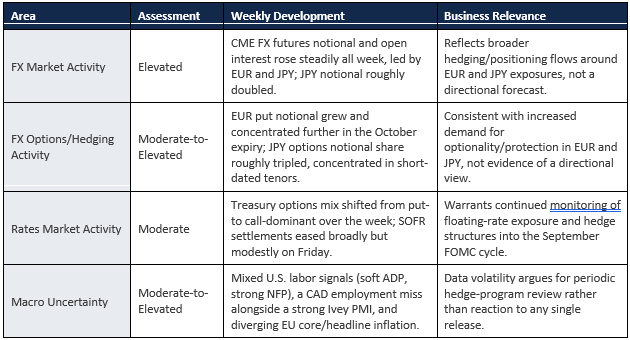
These are qualitative WFG assessments derived from the week’s available source materials, not quantitative risk scores or trading signals.